A Visit to Aesculapius 1880 Sir Edward Poynte: Aesculapius is identified by the snake curled around a staff. In a scene from a poem by...
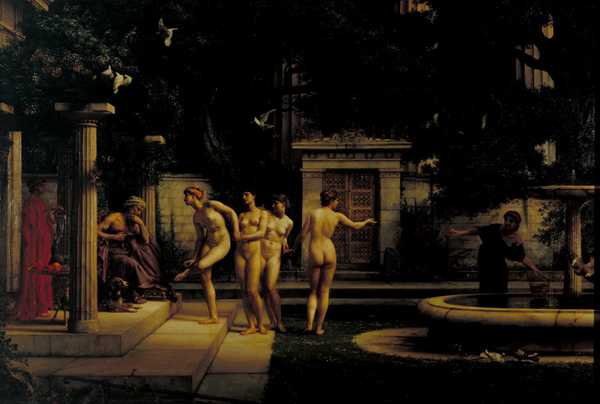
A Visit to Aesculapius 1880 Sir Edward Poynte: Aesculapius is identified by the snake curled around a staff. In a scene from a poem by the Elizabethan Thomas Watson, Poynter shows Venus consulting him, with a thorn in her foot. Venus is identified by the doves, her attributes, and she is accompanied by her handmaidens, the three Graces, who personify grace and beauty. Poynter posed them in the traditional Classical manner, with two of the Graces facing the viewer, while one turns her back. The resulting frieze creates a subtle, elegant rhythm across the composition.
A statue of Asclepius at Epidaurus
Our story begins, naturally enough, in Ancient Greece, whose understanding of medicine and healing was considerably more holistic than the medicine we might recognise today. If a person was sick, and they had the means, they would take themselves to the nearest Asclepion, the equivalent of a hospital, but in practice, more of a healing temple, of which more than 300 were to be found in the varying city-states which made up the Greek nation. The first and most famous of these hospital temples was located at Epidaurus. The Asclepion was named after the god Asclepius, son of Apollo, student of Chiron and father of Hygiea, and the foremost healing deity of the ancient world. Once the patient reached the temple, he or she would undergo a series of purifying rituals designed to prepare the body and mind for what lay ahead. They would eat a simple diet and drink from the mineral-rich, spring-fed pools in the temple precincts. Then, when they were sufficiently rested, they would lie down in the temple itself upon a kline, a bed of sorts (from which we derive the words recline, and clinic), and the healing would begin.
Occasionally, the healing would require some rudimentary surgery, or the equivalent of psychotherapy - conversation with the priests - but the vast majority of the process of healing involved dream work. The Greeks believed that in order to fix the physical body, you first had to heal the ethereal body. After intense preparation, time spent in silence, cleansing the body, making offerings to the Gods, and listening to paeans (musical supplications to the Gods), you would lie down to sleep and, in time, you would receive dream guidance, and hopefully even a miraculous cure, from Asclepius himself.
John William Waterhouse: A Sick Child Brought Into The Temple Of Aesculapius
Many accounts describe such miraculous cures, and the Temple Hospitals endured for many hundreds of years, so we should not lightly dismiss the efficacy of their methods. Indeed, we as astrologers are likely already in sympathy with the method.
Any physical symptom is simply an expression of the astrology at the level of last resort. That psychic impetus that you have not manifested at some level higher-up in the totality of your awareness has – left with no viable alternative – found its way out into the body, and that is the cause of your symptom. Now, you might argue that you did not decide to drink the lead-poisoned water and that it was all the wicked power-company’s fault, but really, you did decide to drink it, because it was an esoteric response to a profound unconscious requirement that you apprehend some vanishingly precise and unique expression of human experience and the only way you could manage it was to move into an area where the water was poisoned by an unscrupulous corporate entity. This, in the astrology, is the cascade effect, which is my own description of it. A single planetary placement evinces a myriad array of vibrational tones, all completely harmonious one with the other, and yet, to the untrained eye, all separate and disconnected. The astrologer sees those gossamer thin filaments that are entirely interconnective however; from the rarefied realms of the peak objective meditational experience, to the most uncomfortable of physical pains, all are contained within the polarities, wellsprings and event-horizons of astrologic placements.
Beyond even this, we have many markers of healing potential beyond the simple manifestations of planetary cause and effect in the soul that, left unchecked, have begun to distort the body. A few of these points are as follows:
Asclepius (4581)
Askalaphus (4946)
Aesculapia (1027)
Hygeia (10)
Chiron (2060)
Hippokrates (14367)
Aegle (96)
Apollo (1862)
Panacea (2878)
Sirona (116)
Feronia (72)
Steve Buscemi, not blessed of Aegle.
The first three, named for Asclepius, represent the propensity toward holistic approaches to healing. Hippokrates seems to imply a more conventional style and is most closely related to doctors as we understand them in our culture. Hygeia has to do with habits, how you approach daily tasks of hygiene and self-care, which have repercussions for health. Chiron often describes a wound or weakness; Aegle is the goddess who bestowed a healthy glow (consider Steve Buscemi, who, to my mind, always looks pale and tired, with Aegle opposing his Sun – Saturn conjunction). Sirona was a later Gallo-Roman healing goddess with the same attributes as Hygeia.
These points tell us different things, although they do not necessarily describe our health issues. Hygeia might give us a clue about the habits that contribute to the eventual manifestation of health problems. Consider here James Gandolfini, whose Hygeia was at the apex of a T-square from Ur/Pl opp. Chiron was ruled by and closely parallel to Jupiter trine the Sun. His diet no doubt contributed to his sudden death. Chiron might give clues to congenital weaknesses in the physiology. Otherwise, the health issues we experience are more likely to be denoted by other placements, and myriad asteroids can relate these fascinating stories.
What these healing-specific points can do, however, is give a picture of healers' beliefs and styles, and how we believe healing should proceed. Where healing has become a vocation, of whatever sort, these placements tell a great deal. For example, Joseph Lister was the first surgeon to link germs and infection and insisted on absolute cleanliness in the operating theatre, especially that scalpels (Mars) be sterile (Hygeia), which are exactly opposed in his chart.
Case Study: Dr Edward Bach
Edward Bach invented the household brand, Bach Flower Remedies. Born in 1886, he spent the spring and summer of 1930, at age 43, discovering and preparing this new healing programme. He also left his wife and children, ditched his Harley Street practice and gave up conventional medicine for good, exactly at his Uranus half-return. The resulting remedies contained no part of the plant, only what Bach claimed was the flower's energy pattern. That winter he treated patients free of charge.
Bach's flower remedies were intuitively derived and based on his perceived psychic connections to the plants. If he felt a negative emotion, he would hold his hand over different plants, and if one alleviated it, he would ascribe to that plant the power to heal that emotional problem. He believed that early morning sunlight passing through dew drops on flower petals transferred the flower's healing power to the water, so he would collect dew drops from the plants and preserve them with an equal amount of brandy to produce a mother tincture, which would be further diluted before use.
While he recognised the role of the germ theory of disease, defective organs and/or tissue, and other known and demonstrable sources of disease, Bach wondered how exposure to a pathogen could make one person sick, while another was unaffected, when to all appearances and analysis they were in equal states of health. He postulated that illness resulted from a conflict between the soul's purposes and the personality's actions and outlooks. According to Bach, this internal war led to emotional imbalances and energetic blockage, causing a lack of harmony and, in turn, physical disease. Bach's remedies focus on treating the patient's personality, which he believed was the ultimate root cause of disease.
Edward Bach: 24 September 1886, 17:20 Birmingham, UK
The astrology is fascinating (selective aspects). You will notice almost immediately the Grand Trine of Flora (the Roman goddess of flowers) with Chloris (the Greek goddess of flowers), and Psyche/Apollo (healing of the spirit). With the inclusion of Chiron, which is precisely parallel to Apollo, this forms a Kite and a Yod with Mars as the apex planet. This denotes a very intense, independent quest, a mission from God, that was ultimately prompted by his close proximity to death in 1917, the year of his Chiron squares, when he had a tumour removed from his spleen and was given three months to live. This is where his quest for alternative approaches to healing began (he developed a prototype homoeopathic medicine in 1919), as 1917 was the year when transiting Uranus squared the Yod’s apex, Mars, and the midpoint of Flora/Chiron. Flora also lies at the midpoint of Pluto and the Ascendant (mortal threat to life). The spleen is sensitised at the 29th degree of Cancer, the exact midpoint of the Sun and Neptune, which is, by Ebertin, the point of sickness in a man. Bach was able to survive this ordeal through holistic self-care, which he carefully nurtured throughout his remaining years. He died at age 50, with Pluto applying to the Sun-Neptune midpoint and Chiron applying to the return.
Chiron the Shaman
Doctor Bach's case underlines the pivotal role of Chiron in his healing paradigm. As the fulcrum planet in two major aspect patterns. Chiron's importance in the chart of a gifted alternative healer should not surprise. If we consider – albeit rather philosophically – the condition of Chiron, we find important correlations that serve our understanding. Chiron is universally known as the Wounded Healer, and while this is commonly understood as a reference to his being struck by a poisoned arrow, causing the mortal wound from which he could not heal, but from which he also could not die due to his immortal nature; he was cursed, therefore, to live in an eternity of pain - I would argue that the woundedness of Chiron was not simply physical. Alone among the entire race of Centaurs, he was wise, self-aware and disciplined, which qualities set him apart from his brethren, to the extent that he lived alone, high up on Mount Pelion. No society was an easy fit, so he lived as one apart. Half man, half animal, he could live as neither one. This outside-ness, this apartness, as is well-known, is the initiating qualification for shamanism. In indigenous cultures, the village knew who the shaman was because he or she was struck by lightning and survived, but any journey into the wilderness (physical or metaphysical) from which one returns changed and deepened might cast one into the role. Chiron was the first astrologer, the first homoeopath and herbalist and used the medicine of the forest to heal the sick. The moment that, like Chiron, we learn to become reconciled with our suffering – whether it be physical, emotional or something else – we are set apart from the vast bulk of humanity who cannot comprehend such a shift. They might suffer, but they are not reconciled, and struggle instead with their ongoing victimhood. The only alternative: acceptance is the Chirotic awakening, the first step on the journey to becoming a shaman.
In Edward Bach’s life, his proximity to death in 1917 was the beginning. Faced every day after with the fragility of his own mortality, he began his Chirotic awakening, and his lifetime’s work – a fundamentally shamanic mission – was born.