Study Taxonomy

Hadean Astrology

Studies & Essays in Hadean Astrology

30 total
12 June 2026 • 7 Min Read Members Only

Orcus in Cancer in the First House

Précis & Overview

Expand
Examining Orcus in Cancer in the First House as an unspoken tribal bargain governing physical presence, body language, and self-presentation, this analysis reveals how conditional...

Examining Orcus in Cancer in the First House as an unspoken tribal bargain governing physical presence, body language, and self-presentation, this analysis reveals how conditional family acceptance -- often brokered through the maternal line and illuminated by the natal Moon -- compels the native to perform an approved identity rather than risk quiet exile. Tracing how challenging aspects to Orcus expose structural fault-lines between family loyalty and authentic adult relationships, it illustrates the internal flattening and emotional distancing -- at times resembling "grey rocking" -- that arise when one's immediate manner is traded for insider status. Ultimately, the telos of this placement reframes banishment from a compromised family system not as a punishment, but as a liberation into quiet self-containment, unvarnished sincerity, and the sovereign gravitas of no longer managing the room's emotional temperature to earn belonging.

3 June 2026 • 10 Min Read Members Only

Orcus in Cancer: Antigone’s Greater Law

Précis & Overview

Expand
Drawing on Sophocles’ tragedy Antigone alongside the philosophical insights of Aristotle and Shakespeare, this essay explores Orcus in Cancer as a moral and psychological crucible...

Drawing on Sophocles’ tragedy Antigone alongside the philosophical insights of Aristotle and Shakespeare, this essay explores Orcus in Cancer as a moral and psychological crucible pitting inherited tribal conformity against a higher, unwritten law of conscience. Both within personal family systems—where unspoken codes and conditional belonging can demand quiet self-negation as the price of inclusion -- and across the wider generational struggle (1954–1979) over national identity, borders, and collective care, the placement asks whether our obligations genuinely serve truth and human wholeness or merely enforce punitive control. Contrasting Orcus’ lower expression of rigid, retributive judgement with its higher expression of justice tempered by mercy and equity, the text shows how true maturity lies in refusing to abandon one's inner truth for tribal approval -- developing instead an independent emotional backbone and a quiet, self-contained integrity that honours only what is sacred and sincere.

21 May 2026 • 8 Min Read Free Essay

The Cathedral in Our Stars

Précis & Overview

Expand
For the past few years, I have been intermittently working on what you might call a back-burner project – a journey through the dark chapters...

For the past few years, I have been intermittently working on what you might call a back-burner project – a journey through the dark chapters of history where societal collapse, depth psychology, and the history of astrology are the main characters. The project is now gaining momentum as I am currently writing the final chapters of this book, and I feel it is the right time to share it with you.

We live in a time that feels increasingly empty of meaning. The old structures that once helped people understand their place in the world – religion, shared myth, stable communities, inherited traditions, even a common sense of truth – have weakened or outright disappeared. In their place has emerged a culture of reaction where unfettered access to information, public performance, outrage, distraction, and opinion provokes almost universal societal division and existential conflict. We are more connected than any civilisation in history, yet many people experience modern life as psychologically scattered and spiritually empty. There are too many voices speaking at once, too many competing explanations of reality, and very little that feels capable of placing our human life inside a larger, meaningful order.

This is not new; throughout history, civilisations have continuously suffered what I term “cathedral collapse.”

A cathedral collapse is not merely the destruction of physical stone walls; it is the systemic shattering of a society's central, guiding myth. It is the moment the axis mundi – the sacred vertical wire pinning heaven to earth – breaks. When the sacred fails to explain experience, humanity is not liberated; it becomes flat. We enter what the poet Robert Bly called the Sibling Society: a godless barren populated by belligerent ideological mobs who have lost their connection to a transcendent mythic principle and are thus left exposed to the raw, unmediated violence of the collective unconscious.

And to add insult to injury, the cathedral collapse of today is absolutely unparalleled. The arrival of the internet, or the “digital swarm” as defined by the philosopher Byung-Chul Han, has created a pervasive perdition that is unprecedented in human history. Never before has a civilisation possessed such immense opportunity for connection while suffering such profound symbolic dislocation. The modern man or woman drifts through an endless ocean of information, stimulation, and manufactured urgency, without any shared vertical structure capable of transforming that experience into meaning. The world is crying out for transcendence and has lost the symbols to transcribe it.

My forthcoming book tracks this recurring cycle through a series of fascinating biographies. It is an exploration of how, at the exact moments history entered its deepest structural crises, the discipline of astrology was re-engineered to act as a new axis mundi – a refuge of meaning and certainty to fall back on when the world was fracturing under immense social, religious, or political pressures.

The book charts the long, arduous development of astrology – showing how it transformed from an ancient, collective, omen-based tool used to predict harvests and the rise and fall of dynasties into the sophisticated personal instrument of deep psychology it is today. We map this development through eight souls, each forged in the chaos of profound civilisational crisis, and view their biographies through the philosophic lenses of Carl Jung, Joseph Campbell, Robert Bly, Byung-Chul Han, and other important thinkers.

Claudius Ptolemy (c. 100 CE) & The Melting Pot of Empire: Alexandria stood at the crossroads of a Roman Empire overflowing with gods, philosophies, mystery cults, sacred traditions, and competing systems of truth. The old local cosmologies of the Mediterranean had not vanished, but they no longer converged into a single shared axis mundi. In response to this symbolic cacophony, Ptolemy transformed astrology into a disciplined mathematical architecture. The Tetrabiblos sought to stabilise celestial meaning within a world becoming saturated by competing explanatory systems, translating the heavens into a universal grammar that was to last more than a thousand years.

Abraham Ibn Ezra (1089–1167) & The Sephardic Dispersion: Set against the unstable world of medieval Iberia – where Islamic courts, Christian kingdoms, and Jewish intellectual communities existed in tense proximity – Ibn Ezra witnessed the destruction of the Andalusian Sephardic order under the Almohads. Forced into decades of exile across Christian Europe, he developed new systems of planetary strength and translated the mathematical and astrological sciences of the Arabic world into Hebrew, preserving a sophisticated cosmological tradition for displaced Jewish communities cut loose from their former institutional centres.

Guido Bonatti (c. 1210–1296) & The Italian Civic Terror: Amid the violent struggles between Guelph and Ghibelline factions in medieval Italy, Bonatti transformed astrology into a disciplined instrument of political and military judgement. In the Liber Astronomiae, he systematised horary and electional practice with exceptional procedural rigour, adapting astrology to a world in which rulers, cities, and alliances shifted constantly beneath the pressure of war and factional instability.

Philipp Melanchthon (1497–1560) & The Protestant Reformation: As the Reformation shattered the sacramental unity of Western Christendom and Europe descended into religious conflict, Melanchthon, a close friend of Martin Luther, incorporated astrology and astronomy into the educational reforms of Wittenberg. He regarded the mathematical regularity of the heavens as evidence of divine providence and rational order at a time when political and religious authority on earth was becoming increasingly unstable.

William Lilly (1602–1681) & The Killing of the King: During the political and symbolic upheaval of the English Civil War, when monarchy, church authority, and inherited hierarchy were violently contested, Lilly transformed astrology into a widely accessible public practice. Writing in vernacular English rather than inaccessible Latin, he used horary astrology to help ordinary readers navigate a world in which older structures of legitimacy no longer appeared stable or unquestionable.

Alan Leo (1860–1917) & The Victorian Spiritual Crisis: As scientific materialism, industrialisation, and evolutionary theory weakened many traditional religious certainties in the modern West, Alan Leo radically reorientated astrology away from fate and prediction and toward character, temperament, and spiritual development. In doing so, he helped transform astrology into a psychological and esoteric discipline capable of surviving within an increasingly secular intellectual world.

Alfred Witte (1878–1941) & The Age of Global War: Driven by the upheavals of industrial warfare, social dislocation, and the rise of totalitarianism in Europe, Witte sought a more precise and technical astrological language capable of describing the increasingly impersonal forces shaping modern life. Through the Hamburg School and Uranian astrology, he introduced planetary midpoints and hypothetical trans-Neptunian points, extending astrology into a highly systematic method for analysing collective and psychological pressures within the new technological age.

What this immense project reveals is an eternal psychological law: human archetypes do not disappear when we dismantle our temples and depose our gods; they return as diseases. Diseases of the mind, the spirit, and ultimately, the collective unconscious. When a society begins to believe it has outgrown its stories, the contents of the unconscious mediated by those stories return in degraded, pathological, and highly compulsive forms. Society’s repressed Shadow begins to infect the collective unconscious, causing mass neurosis.

This brings us directly to our own era. As we navigate the fragmented, digital swarms of the twenty-first century, we are facing an acute phase of civilisational flattening, unprecedented in scope. The smartphone has given the entire planet access to eruptions of unresolved mass trauma, and we daily commune directly with humanity’s Shadow without any mediating symbolic filter.

That is why I believe the natural next step in this lineage – and the final frontier explored in the closing chapters of my work – is the study of Hadean astrology.

If the astrology of the ancient world was about preparedness for famine and dynastic upheaval, and the astrology of the twentieth century was about integrating the new psychology into human consciousness, Hadean astrology is the symbolic work of the underworld, both individually and collectively. Hadean symbols give us the language to describe the new pathologies of the digital age: the sicknesses of narcissism, fake personas, compulsive performance, and habitual gaslighting. They also give us tools to understand these dysfunctions that have begun to atrophy into the global psychosis that is unfolding all about us today.

Hadean astrology is not a Cosmo personality quiz; it is not light, soothing, or fun; it is an orientation for coming to terms with the Shadow of today's society and learning its symbols and signs. It is the reclamation of the axis mundi as the only possible salvation in an increasingly fragmented and senseless worldwide drama.

The book is nearing completion. Over the coming days and weeks, as I draft these final chapters, I’ll be sharing deep dives into these specific historical insights, the technical astrological breakthroughs of the past, and the psychological mechanics they reveal.

If you are ready to look past the deafening noise of the modern digital landscape and re-engage with the severe, beautiful geometry of human meaning, what I call the Telos of Orcus, I invite you to join the conversation.

30 April 2026 • 23 Min Read Members Only

Paradise Lost, Paradise Found – Pluto and the Alchemy of the Ashlar

Précis & Overview

Expand
Synthesising Jungian depth psychology, stonemasonry symbolism, and the four Hadean archetypes -- Pluto, Achlys, Ixion, and Orcus -- this essay maps the journey of individuation...

Synthesising Jungian depth psychology, stonemasonry symbolism, and the four Hadean archetypes -- Pluto, Achlys, Ixion, and Orcus -- this essay maps the journey of individuation from superficial conformity to authentic selfhood. Contrasting the vast, amorphous Shadow Ocean of Pluto with the twin defensive strategies we build to avoid drowning in our own depths -- Achlys’ subtractive self-erasure and Ixion’s additive grandiosity -- it shows how prolonged repression breeds neurosis and internal division. Through the teleological pull of Orcus, life’s rejections, midlife Hadean squares, and periods of isolation act as the sculptor’s chisel, stripping away false personas and transforming the jagged "Rough Ashlar" of the ego into a perfected, transparent instrument for the Divine Spark.

24 April 2026 • 15 Min Read Members Only

Orcus and the Night Sea

Précis & Overview

Expand
Tracing the ancient motif of the Night Sea journey from Egyptian and Mesopotamian myth to the depth psychology of Carl Jung and Joseph Campbell, this...

Tracing the ancient motif of the Night Sea journey from Egyptian and Mesopotamian myth to the depth psychology of Carl Jung and Joseph Campbell, this essay explores the astrological archetype of Orcus as the Lord of the Oath and guardian of the non-negotiable. Through personal dreams, transits, and periods of solitary pilgrimage, it examines what happens when the external world fails to mirror our inner depth and the social self dissolves. Stripping away the need for audience, validation, and borrowed identities, the initiation of Orcus confronts the seeker with a single, uncompromising question -- who are you when no one is watching? -- and reveals the hard-won sovereignty of standing by an inviolable truth without witness or reward.

9 April 2026 • 11 Min Read Members Only

Achlys in the Houses

Précis & Overview

Expand
Examining the astrological placement of Achlys across all twelve houses, this piece maps how early relational wounding teaches the psyche to disappear from specific domains...

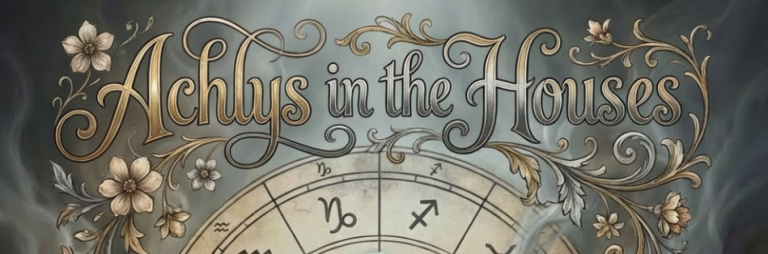
Examining the astrological placement of Achlys across all twelve houses, this piece maps how early relational wounding teaches the psyche to disappear from specific domains of human experience before they can invite rejection, shame, or emotional withdrawal. Whether suppressing basic selfhood and material appetite in the 1st and 2nd houses, muting curiosity, domestic refuge, and joyful play in the 3rd through 5th, or abandoning bodily stewardship, intimate partnership, and psychic vulnerability in the 6th through 8th, each placement traces a distinct survival strategy of strategic self-erasure. Extending through the 9th to 12th houses—where hope, worldly ambition, collective belonging, and private sorrow are similarly disowned—the text reveals how traits that appear in adulthood as maturity, humility, asceticism, sophistication, or serene detachment are often sophisticated defensive adaptations, leaving the individual subtly absent from their own desires, visibility, and lived depth.

5 January 2026 • 7 Min Read Members Only

She’s not There: Achlys and the False Self

Précis & Overview

Expand
Exploring the structural resonance between Donald Winnicott’s theory of the True and False Self and the astrological archetype of Achlys, this essay grounds the "mist...

Exploring the structural resonance between Donald Winnicott’s theory of the True and False Self and the astrological archetype of Achlys, this essay grounds the "mist of non-existence" in early developmental experience. Tracing how an unattuned or emotionally dangerous caregiving environment forces a child to suppress spontaneous gesture in order to preserve attachment, it shows how the False Self—and Achlys’ atmospheric camouflage -- functions not as moral deception or compensatory grandiosity (like Ixion), but as a necessary ornament placed upon a protective shield. Ultimately, the piece clarifies that what presents in adulthood as competence, composure, and social acceptability often conceals an inward sense of unreality, inviting the slow, compassionate work of understanding why the mask was once required so the hidden True Self can safely re-emerge.

2 January 2026 • 8 Min Read Members Only

Telling it Like it Isn’t: Achlys and the Politics of Illusion

Précis & Overview

Expand
Examining contemporary British politics through a non-partisan Achlysian lens, this essay contrasts the natal T-squares of Nigel Farage and Keir Starmer to reveal two mirror...

Examining contemporary British politics through a non-partisan Achlysian lens, this essay contrasts the natal T-squares of Nigel Farage and Keir Starmer to reveal two mirror distortions in how political truth is mobilised when integrity is absent. Where Farage’s Saturn–Uranus opposition squared by Achlys on the Midheaven weaponises blunt provocation -- framing norm-breaking disruption as dutiful realism -- Starmer’s Sun–Pluto opposition to Jupiter squared by Achlys anesthetises accountability, using procedural, moralising vocabulary to veil underlying power interests. Ultimately, the piece argues that neither vulgar exposure nor refined technocratic reassurance can heal a fractured collective narrative on its own; Achlys merely strips away unsustainable illusions, leaving the deeper task of reuniting truth with ethical responsibility to Orcus.

30 December 2025 • 12 Min Read Members Only

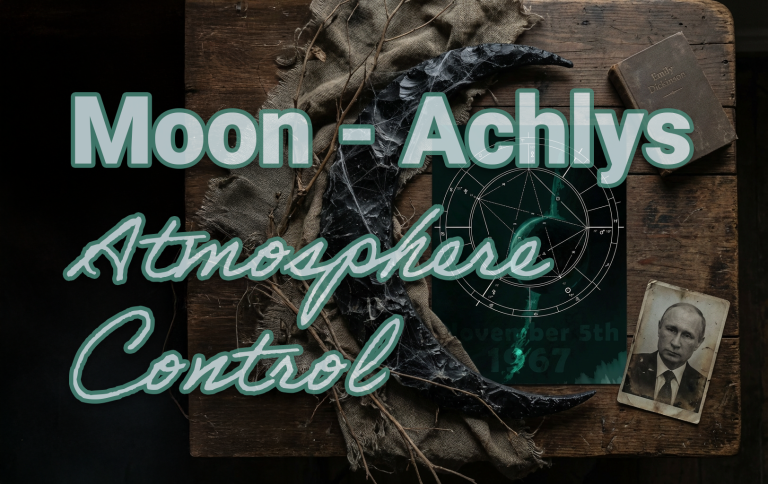
Moon – Achlys: Atmosphere Control

Précis & Overview

Expand
Examining the natal Moon–Achlys conjunction as an early-learned lunar survival skillset, this essay explores how growing up in an emotionally constricted, fragile, or unsafe domestic...

Examining the natal Moon–Achlys conjunction as an early-learned lunar survival skillset, this essay explores how growing up in an emotionally constricted, fragile, or unsafe domestic atmosphere teaches the child that unshielded feeling invites annihilation or loss of belonging. Tracing how this foundational wound bifurcates into two mirror strategies -- the hyper-sensitive retreat into solitude and symbolic containment, exemplified by Emily Dickinson’s "slant" truth, and the "atmosphere-maker" who controls the relational field through affective withholding and freezing fog, illustrated by Vladimir Putin -- it reveals how both poles originate in the visceral discovery that emotion is power. Ultimately, the piece argues that whether one disappears from the storm or becomes it, Moon–Achlys masks the unedited self for emotional survival until crisis calls that hidden power back into conscious authenticity.

22 December 2025 • 7 Min Read Members Only

Illusion’s Half-Life: Achlys, Orcus, and the Moment of Exposure

Précis & Overview

Expand
Examining how Achlysian illusions are seeded in the parental field and inherited as identity, this essay uses the natal charts and transits of Bernie Madoff...

Examining how Achlysian illusions are seeded in the parental field and inherited as identity, this essay uses the natal charts and transits of Bernie Madoff and his father, Ralph Madoff, to illustrate the Hadean interplay between protective mirage and enforced integrity. Tracing how Ralph’s Moon–Achlys square and Jupiter–Pluto tension forged a family script aimed at concealing immigrant poverty and thwarted financial ambition, the analysis shows how that unpalatable truth was perfected in Bernie’s chart via a rare Sun–Achlys Cazimi conjunction embedded within a Taurus stellium alongside Uranus and Kronos -- granting an effortless mastery in projecting the image of the brilliant financier over a hollow fraud. Ultimately, by mapping the 2008–2009 collapse of Madoff’s Ponzi scheme against transiting Orcus crossing his Ascendant alongside hard Pluto–Ixion and Achlys–Orcus contacts, the piece demonstrates the uncompromising Hadean law: while defensive illusions are permitted for survival, once they harden into identity, Orcus inevitably intervenes to dissolve the mist and compel a reckoning with reality.

11 December 2025 • 8 Min Read Members Only

Achlys Cazimi – the Beautiful Illusion, and its Denouement

Précis & Overview

Expand
Examining the rare Sun–Achlys Cazimi conjunction as an exaltation of mythic self-idealisation, this essay explores how seated illusion at the heart of solar identity confers...

Examining the rare Sun–Achlys Cazimi conjunction as an exaltation of mythic self-idealisation, this essay explores how seated illusion at the heart of solar identity confers magnetic destiny while carrying the inevitable seed of disillusionment. Contrasting the trajectories of Rudyard Kipling and Saddam Hussein -- alongside the Hadean Cazimi signatures of William Blake and Carl Lewis -- it demonstrates how the same configuration can elevate a figure into the persuasive voice of an imperial dream or the violent enforcer of an authoritarian cult of personality. Ultimately, the piece argues that because no illusion built on self-unawareness can endure unchallenged, the true measure of Achlys Cazimi lies in how the native meets the inevitable unveiling: whether inwardly through conscience, grief, and humbled humanity, or outwardly through public ruin and unyielding denial.

8 October 2024 • 4 Min Read Free Essay

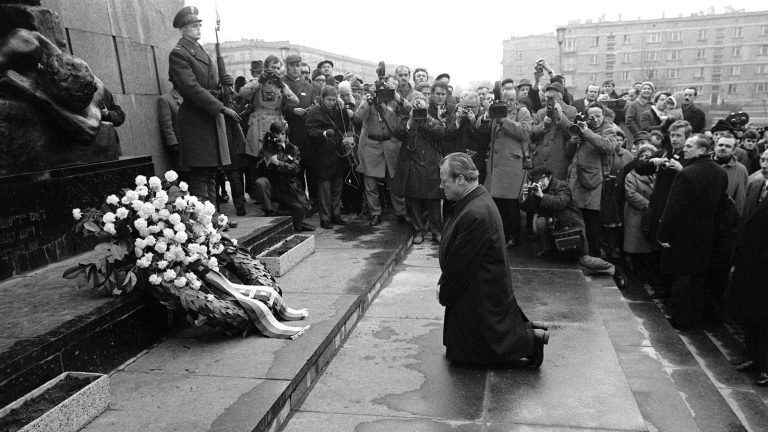
The Kniefall von Warschau and Other Hadean Musings

Précis & Overview

Expand
Examining the generational and biographical impact of overlapping Hadean squares -- when slow-moving trans-Neptunian bodies square their natal positions concurrently or at unusually young ages...

Examining the generational and biographical impact of overlapping Hadean squares -- when slow-moving trans-Neptunian bodies square their natal positions concurrently or at unusually young ages -- this essay traces how specific historical cohorts are compelled into sudden psychological and spiritual reckonings. Illustrating the 1913 cohort’s simultaneous Pluto and Orcus squares through West German Chancellor Willy Brandt’s historic 1970 *Kniefall von Warschau* at the Warsaw Ghetto, alongside the early-life Hadean awakenings of Winston Churchill, Victor Hugo, and Mary Shelley, the analysis maps out how these transits strip away collective and personal facades. Finally, turning toward the 1946–1947 generation and the millennial cohort born around the turn of the century with natal Pluto–Ixion conjunctions in Sagittarius, the piece anticipates how upcoming concurrent Pluto–Ixion squares in midlife will force an abrupt confrontation with curated self-presentation and existential authenticity.

7 October 2024 • 8 Min Read Members Only

Vocations IV

Précis & Overview

Expand
Examining how vocational direction evolves across the lifespan through the astrology of the earth houses (2, 6, and 10) and their natural rulers -- Venus,...

Examining how vocational direction evolves across the lifespan through the astrology of the earth houses (2, 6, and 10) and their natural rulers -- Venus, Mercury, and Saturn -- this essay maps the shift from early-life house placements to the deeper, more nuanced engagement with house rulers that emerges after midlife. Framing the midlife transits of Uranus, Neptune, and Pluto -- alongside the later Hadean squares of Ixion and Orcus -- as a series of existential validity checks, it explores how these outer-planet passages confront the sunk-cost fallacy, expose hollow facades, and test whether our careers reflect authentic soul-purpose rather than mere habit. Ultimately, the piece argues that navigating this transition requires the courage to strip away what has grown stale and realign one’s craftsmanship with genuine passion and meaning.

28 May 2024 • 4 Min Read Free Essay

Walls and Curtains: the Trial of Donald Trump

Précis & Overview

Expand
Examining Donald Trump’s progressed chart and transits during his criminal trial, this essay interprets his progressed Scorpio Ascendant -- ruled by Pluto positioned on the...

Examining Donald Trump’s progressed chart and transits during his criminal trial, this essay interprets his progressed Scorpio Ascendant -- ruled by Pluto positioned on the progressed Midheaven -- as a stark public exposure of private impulses, power dynamics, and hidden behaviours. Tracing how transiting Chiron conjunct natal Hygiea activates his natal Chiron in Libra in the 2nd house, the analysis connects his ongoing grievances over legal fairness to his lifelong progressed Uranus–Orcus conjunction in the 8th house of sex, money, and secrecy -- an aspect rooted in his natal 10th-house Sun opposition to the 4th-house Moon. Ultimately, invoking Marcus Aurelius’ warning against desiring anything that requires "walls and curtains," the piece argues that regardless of the courtroom verdict, Orcus enforces an inescapable reckoning with public accountability whenever privilege is mistaken for exemption from integrity.

16 May 2024 • 13 Min Read Members Only

Orcus the Stoic, Ixion the Epicure

Précis & Overview

Expand
Bridging Hadean astrology with classical philosophy, this essay maps the polarity between Orcus and Ixion onto the enduring tension between Stoic self-command and Epicurean indulgence....

Bridging Hadean astrology with classical philosophy, this essay maps the polarity between Orcus and Ixion onto the enduring tension between Stoic self-command and Epicurean indulgence. Contrasting Ixion’s craving for audience, novelty, and sensual excess -- which inevitably leads to satiation, jadedness, and joylessness -- with Orcus’ ascetic simplicity, gratitude, and inward integrity, it illustrates how these opposing currents manifest through the natal chart of Roman Emperor Marcus Aurelius, whose Sun–Orcus opposition and Moon–Saturn mutual reception embodied the discipline of earned rewards. Ultimately, the piece argues that neither rigid puritanism nor unrestrained hedonism serves the soul; true maturity lies in consciously balancing self-discipline with self-tolerance, discovering richness in wanting what one already has rather than exhaustively chasing what one lacks.

30 May 2022 • 8 Min Read Free Essay

Eris the Iconoclast, Part 1

Précis & Overview

Expand
Challenging modern pop-astrological readings that cast Eris as an uplifting emblem of feminist empowerment, this essay returns to classical Greek myth to recover her starker,...

Challenging modern pop-astrological readings that cast Eris as an uplifting emblem of feminist empowerment, this essay returns to classical Greek myth to recover her starker, more unsettling nature as Discordia -- the uninvited goddess of strife whose seemingly innocuous provocations ignite disproportionate ruin. Tracing her mythological lineage alongside her demonic brood and contrasting her indirect, waspish agitation with overtly martial goddesses like Bellona and Enyo, the analysis explores how Sun–Eris conjunctions manifest across polarised public figures such as Piers Morgan, Erica Jong, and Anita Bryant. Ultimately, the piece distils Eris into a taxonomy of contrarian, divisive, and impenitent disruption -- explaining why her archetype thrives in an era of media outrage and manufactured culture-war discord.

4 February 2022 • 9 Min Read Free Essay

Pluto Work

Précis & Overview

Expand
Examining the psychological and spiritual mechanics of "Pluto work," this essay explores how Pluto operates covertly as an unconscious, compulsive force that can only be...

Examining the psychological and spiritual mechanics of "Pluto work," this essay explores how Pluto operates covertly as an unconscious, compulsive force that can only be glimpsed through external crises, power struggles, and retrospective introspection. Arguing that no ego consciously chooses Plutonic transformation -- and that Neptune’s surrender serves as the essential antidote to Pluto’s battles of annihilation -- the analysis traces how midlife Pluto squares and relentless external adversaries compel us to confront deep-seated anxieties, discard exhausting illusions of control, and abandon fruitless retaliation. Ultimately, the piece defines mastery of the "Hadean game" as preserving one's grace and dignity under unjust provocation, transforming disempowerment into a detached spiritual maturity where one finally becomes "the adult in the room."

30 July 2021 • 16 Min Read Members Only

The US Ixion Return: Final Part

Précis & Overview

Expand
Concluding a four-part series on the 2021–2022 United States Ixion return alongside concurrent Neptune half-returns, this essay interprets the five-pass cycle as the birth of...

Concluding a four-part series on the 2021–2022 United States Ixion return alongside concurrent Neptune half-returns, this essay interprets the five-pass cycle as the birth of a new, quarter-millennium American oligarchic paradigm anchored in legislative power (the 11th house), science (Aquarius), and the medical-pharmaceutical complex (prominent Hygiea, Chiron, and asteroid Hippokrates). Contrasting the initial February 2021 chart -- where an unafflicted Ixion trine Uranus on the Midheaven signals societal admiration for wealthy technocratic elites -- with the December 2021 middle pass and October 2022 culmination, the analysis traces how institutional oligarchy quietly co-opts establishment structures to drive upward wealth transfers while marginalising dissent and straining public health. Ultimately, tempering its mundane projections with a reflection on the vast complexity of predictive astrology, the piece frames these Hadean returns as an unfolding blueprint of concentrated patrician power rather than an inevitable fate.

20 July 2021 • 7 Min Read Members Only

The US Ixion Return, Part 3

Précis & Overview

Expand
Examining Ixion at 1° Capricorn in the 1776 US natal chart -- opposing Venus and Jupiter in Cancer while governed by a tenth-house Libra Saturn...

Examining Ixion at 1° Capricorn in the 1776 US natal chart -- opposing Venus and Jupiter in Cancer while governed by a tenth-house Libra Saturn -- this essay traces how the archetype of oligarchy operates through legislative capture and political sleight of hand. Contrasting modern free-market rhetoric with the radical egalitarianism of the Revolutionary era, from Pennsylvania's 1776 progressive tax codes to the warnings of Noah Webster and Gouverneur Morris, it reveals how the founding republic actively guarded against concentrated private wealth -- a safeguard eroded over a single Ixion cycle.

22 May 2021 • 2 Min Read Free Essay

Jupiter – Ixion

Précis & Overview

Expand
Examining the early November conjunction of Jupiter and Ixion -- flanked by Kassandra and Orpheus and opposing Chaos and Pandora -- this essay explores how...

Examining the early November conjunction of Jupiter and Ixion -- flanked by Kassandra and Orpheus and opposing Chaos and Pandora -- this essay explores how Jupiter’s expansive, establishment-ruling principle magnifies Ixion’s archetype of elite privilege and impunity. Connecting this mundane signature to contemporary scandals -- from Prince Andrew’s Epstein interview and military war-crime cover-ups to religious persecution and political smearing -- it illustrates how entrenched institutional power shields itself while projecting its shadows outward.