
Pain will inevitably arise, and events will unfold that we desperately wish were not happening. In the Buddha’s teaching of the two arrows, a person struck by an arrow is struck again. The second wound compounds the first. So, too, painful feelings can be compounded by the distress with which we meet them. In the Sallatha Sutta, the uninstructed person experiences both physical and mental pain; the well-instructed disciple experiences the physical pain without the same added mental anguish. [1]
So he feels two pains, physical and mental.
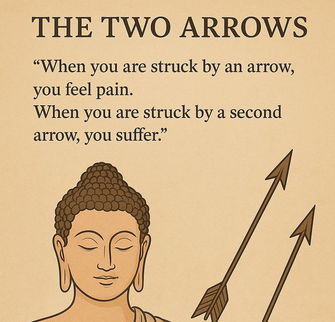
The first arrow is the wound. The second is what gathers around it: resistance, recrimination, the insistence that what has happened must somehow not have happened. In this way, life’s calamities can become occasions for an additional torment. Bereavement, financial ruin, illness, or any number of unlooked-for misfortunes may arrive without our consent. We cannot always prevent the wound. The teaching asks whether we must keep wounding ourselves.
We must be careful, however, with the familiar claim that the second arrow is optional. The Buddha distinguishes the trained disciple from the untrained person; he does not describe a simple switch that anyone can throw at will. Pain is not a moral failure, and neither is the first involuntary movement of grief or fear. The possibility is not that we can command ourselves never to suffer. It is that our relation to suffering can be cultivated. We can learn to lessen the wound of the second arrow.
Epictetus, writing centuries later, conceived of a related distinction:
“Some things are in our control and others not. Things in our control are opinion, pursuit, desire, aversion, and, in a word, whatever are our own actions. Things not in our control are body, property, reputation, command, and, in one word, whatever are not our own actions.” [2]
The Buddhist and Stoic formulations are not identical, but they meet at an important threshold: an event and our relation to it are not necessarily the same thing. We may have no power to undo what has happened, yet retain some possibility of shaping what follows. This possibility is not always immediate, and it is not equally available in every condition. It is nevertheless a possibility worth cultivating. Here, I shall use Ananke to name the first arrow: the necessity of what we cannot now make otherwise. Our reaction to it is not sovereign in the same absolute sense. Yet neither is it always fixed. Of course, this movement is not necessarily easy. Sometimes it is the work of a lifetime. But the distinction opens a space between being wounded and making the wound the whole of our existence.
Thanks for your support.
Until next time,

[1] hanissaro Bhikkhu, trans., “Sallatha Sutta: The Arrow,” SN 36.6, Access to Insight, 1997, revised November 30, 2013, https://www.accesstoinsight.org/tipitaka/sn/sn36/sn36.006.than.html.
[2] Epictetus, Enchiridion, sec. 1.
A comment talking about the dichotomy of control.