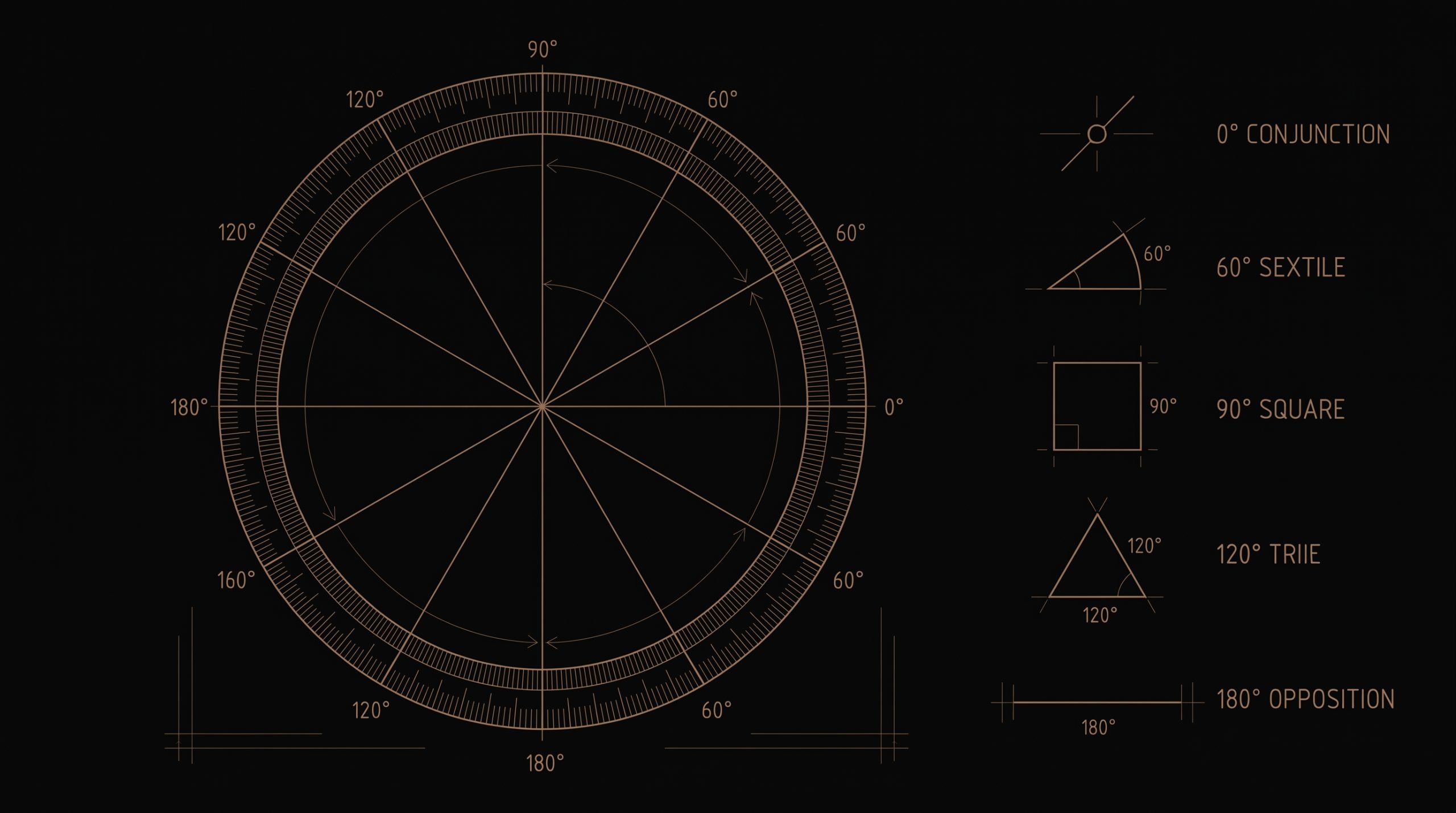
We have spent some considerable time and energy looking at and attempting to understand the fundamental and underlying significance of aspects; aspects of whatever stripe. This is because, as astrologers, we spend a great deal of time trying to grasp some kind of essence of how aspects work, without perhaps realising that there is an even deeper apprehension to be made. I hope that after looking at the intriguing cases of the writers Fitzgerald and Nabokov, we can see certain key principles quite clearly. We can perhaps conclude that:
- Easy aspects tend to lead us to seek comfort and ease. This creates a circular logic: by seeking it, we attain it, but that same aversion to effort accumulates, over time, a lack of achievement that manifests as dissolution. This is the nature of Jupiter.
- Hard aspects, by contrast, give an aversion to comfort and ease. This can make life feel difficult, but the general trajectory, due to the attention to work and attainment, and in fact the nigh-on inability to relax, is toward success. This is the nature of Saturn.
This gives us another perspective too on the nature of Jupiter and Saturn, and the received wisdom about those planets. Specifically, it lets us reframe the simplistic idea that Jupiter is good and Saturn is bad. It is better to say that Jupiter is easy, and Saturn is hard. But as we all know, a smooth sea never made a skilled sailor, and almost everyone believes that, while they did not choose the great hardships and challenges of their lives, they would not, after the fact, choose not to have lived through them. Often, we are made through the great upheavals we endure. So, in truth, whilst most of us would vote for ease, we rarely applaud it in retrospect.
And this means that we can divine an overall tenor from the balance of these contending fundamentals. This works in the same way as those other oft-ignored fundamentals, the distribution of modes and elements. A chart made primarily of Earth and Water will be profoundly and qualitatively different to the Air and Fire chart regardless of all other factors.
But in the majority of cases, the propensity toward one condition or the other is not likely to be so marked as with Fitzgerald and Nabokov, and we will find that we have a more equal divide between ease and difficulty in the chart. We can see where we have that innate propensity for relaxing into situations and circumstances that in the long term might become stagnant and passive. We can see also those areas where we simply cannot easily relax, and have to chip away at the task, even when we would rather not.
Let us look then at another writer of genuine quality and see what we can learn with these principles in mind.
Case Study: Donna Tartt
To seamlessly segue into the slightest synchronicity, she said of her small stature when preparing for fame in 2014: “I’m the exact same size as Lolita. Do you remember that poem from the novel?” She recites:
Wanted, wanted: Dolores Haze
Her dream-gray gaze never flinches.
Ninety pounds is all she weighs
With a height of sixty inches.
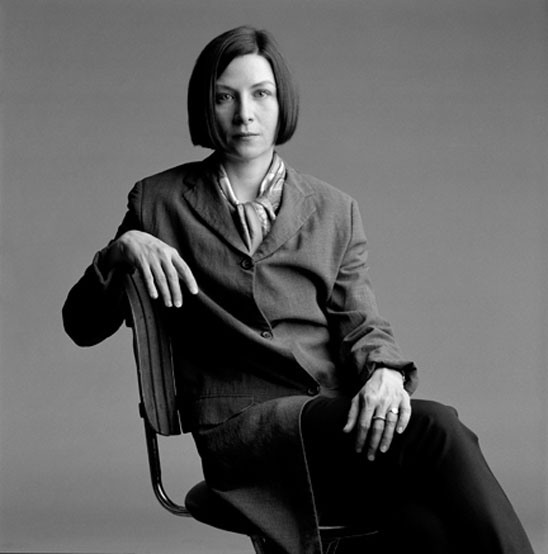
And this is true, since she allegedly sourced most of her outfits from Gap Kids as a university freshman. But it’s interesting that she was anticipating fame in 2014. She hadn’t yet published her first novel, and she was already being talked about as the next literary sensation. Publishers, though, had been queuing up to be the chosen purveyor of The Secret History until the auction winner, Knopf, paid a staggering $450,000. For a first novel. Many bestselling books never make this return on royalties in twenty years.
But Tartt was always unusual.
“When I was a little kid, first thing I memorized were really long poems by A. A. Milne,” she says. “Then I went through a Kipling phase. I could say ‘Gunga Din’ for you. Then I went into sort of a Shakespeare phase, when I was about in sixth grade. In high school, I loved loved loved Edgar Allan Poe. Still love him. I could say ‘Annabel Lee’ for you now. I used to know even some of the shorter stories by heart. ‘The Tell-Tale Heart’—I used to be able to say that.
“I still memorize poems,” she says. “I know ‘The Waste Land’ by heart. ‘Prufrock.’ Yeats is good. I know a lot of poems in French by heart. A lot of Dante. That’s just something that has always come easily to me. I also know all these things that I was made to learn. I’m sort of this horrible repository of doggerel verse.”
This speaks to a remarkable childhood condition, but Tartt’s childhood is itself a secret history. Once, when challenged that her short story entitled A Southern Gothic Childhood, With Codeine, was autobiographical, she responded quite aggressively:
“That is a short story. It is a short story. It’s a short story. I was very upset when it appeared in Harper’s with the designation ‘memoir’. It’s a short story. It’s a short story.”
She digressed then into the similarities between the short story collection Nabokov’s Dozen and his autobiography Speak, Memory. ‘
‘If you are reading his autobiography you see very clear elements of these stories of Russian childhood,” she concludes. ”But, you know, he chooses to call them stories. And [A Southern Gothic Childhood, With Codeine] is a story. I’m glad you asked me that. I’m glad to clear that up.”
But Tartt kept meticulous diaries throughout her childhood, and in another 1992 essay, she wrote about her “skittish, immature mother” and “dashing but feckless father” and the bevy of great-aunts and grandfathers who brought her up. From a baby so small she wore doll clothes, she grew into a sickly child dosed on whiskey and cough syrup by her great-grandfather.
“I spent nearly two years of my childhood submerged in a pretty powerfully altered state of consciousness … I was convinced that I would die soon.”
To my mind, and in the same vein as that of Edward Bach, this seems pivotal and profound. We can see right away the Talent Triangle of Mercury (writing) in the 4th house of early life, with Neptune (whiskey and cough syrup) and Pluto in the 12th (an amorphous fear of death). This precarious state of health and vigour seems to have triggered her peculiar early studies in literature. We can see that Sun, Moon and Venus are all in a peregrine state, with Sun, creativity, the most peregrine of these, on the Aries point (meaning 0° Cardinal) which always promises some measure of fame or notoriety, and most decidedly angular on the 4th house cusp, the Imum Coeli, the most private and lunar of all positions. The Moon too is adrift, but undoubtedly connects by trine to Neptune, albeit a little widely to negate her peregrination. These two placements rather echo one another. They are set deep, separate, removed from the outer world.
The Talent Triangle intimates her natural and easy ability as a writer. Now imagine if there were no hard aspects to be seen. We would look and think, ‘there may be trouble ahead’ because it is clear that her talent was precocious, so now we try to see what there is to sustain it, and this is where we consider the hard aspects, because this is what perpetuates talent into substance and gives it form and longevity. Saturn squares
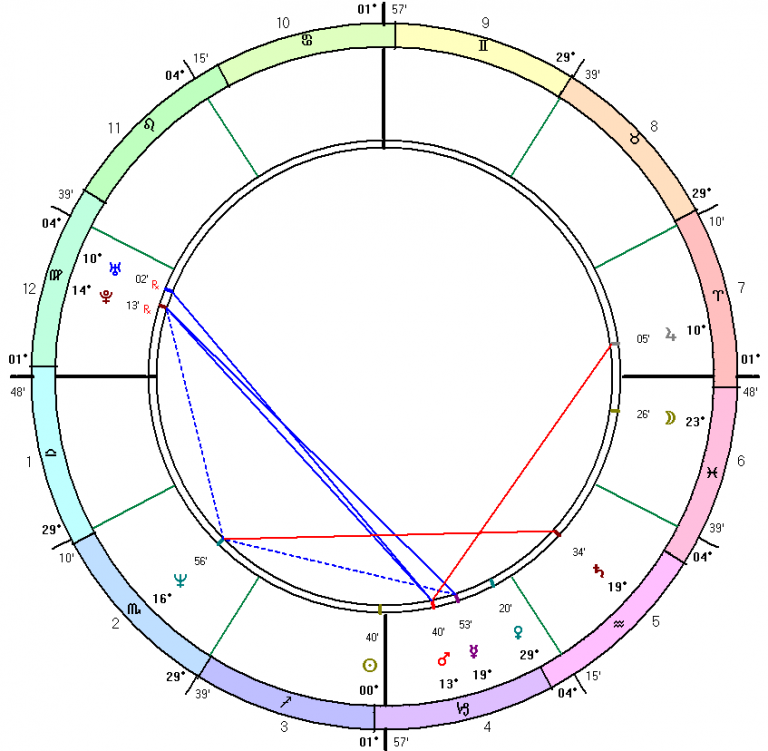
Neptune from the 5th house, where all purely creative endeavours are born. Tartt’s novels are works of profound duration; it took 10 years to write her second novel. “I can’t write quickly.” She has always enjoyed, or endured, a painstaking perfectionism. The Secret History took eight years.
“If I could write a book a year and maintain the same quality, I’d be happy,” she once said. “But I don’t think I’d have any fans.”
When Saturn contends with Neptune, there is a nagging spur that one must create a form for the nebulous and fleeting, structure it, make it flesh. It is the poet’s work ethic: describing the indescribable in cosmic shorthand. Once she said this:
“I have written essays and short stories and even a poem or two. I’ve written some short things. In general, though on a big piece – I am interested in working on it over a long period of time. I like spending a long time with a project. There’s a level of richness you get when you put a whole decade into a book that just isn’t possible if you spend two or three years on it. And that’s fine; not everybody wants that in a book. There are books that don’t aim for that quality and not every reader admires that quality. But definitely the fact of spending a long time on something, it gives the book a hidden weight. It’s a hidden anchor. You can feel the time that’s been put into it.”
This perfectly captures Saturn in the 5th.
This is a common Saturn-in-the-5th dynamic. Bob Dylan, who shares the placement, claims it took him two years to write the song Tangled Up in Blue. He also said of songwriting:
“Let’s face it. You’re either serious about what you’re doing or you’re not serious about what you’re doing. And you can’t mix the two.”
Dylan, by contrast, still wrote some of his songs very quickly; the key observation is that 5th house Saturn doesn’t block creativity; rather, it brings seriousness and deliberation, and that always comes across. In many ways, Saturn seems to run counter to the notion of creativity because it is the antithesis of spontaneity, but when you consider craftsmanship, you can appreciate how well it fits in the 5th house. This idea of a long apprenticeship concisely reflects Saturn placed here. So it’s no wonder Donna Tartt has taken nearly a decade to write each of her three novels. The underpinning influence of this 5th house Saturn, insistently driving the need to give form to her inner vision, over years and years, is absolutely crucial to supporting the easy talent of the Mercury aspects and ensuring that her adolescent propensity to literature, and to memorising great works of poetry, was raised up to become something other than a quirk of an unremarkable life.

We can perhaps speculate further. It is long rumoured that she is a celibate, and this is again supported by a 5th house Saturn, but perhaps more so by the other square in her chart, that between Mars and Jupiter. Easy aspects between these two can often give a great freedom in almost casual carnal encounters, not unlike Zeus’ approach to pursuing the many objects of his desire. So, a trine gives joy in such romping about, if you like. The square, though, creates tension, delay and caution with the prospect, and with Mars in the 4th, there is a childhood programming; perhaps redolent of that Baptist morality that pervades the Southern states. See how Mars in the 4th rules Jupiter in the 7th? The husband prototype conforms to an early expectation fostered among family and homestead. It’s well known that Tartt was mostly raised by her grandfather and, in equal measure, her great-grandfather. Perhaps they just don’t make men like that anymore, and that is why she has never been tempted into a relationship. Plus, if you look at the wider chart, you will see Jupiter at the apex of a T-square, with Mars opposing Orcus. She really perhaps prefers her independence to the extent that she cannot support any serious interruption of it. And Mars is ruled by Saturn too, so she is, in a real way, in love with her work and doubtless has no time or attention to spare for courting. Plus, that Saturn is in Aquarius. Once she said:
“I do find friendship more compelling to write about than romantic love. I am not interested in marriage and maternity novels. For me, the quest is to write something with a rip-roaring effect; I get that from stories that combine friendship and adventure.”
She also once said, “je ne vais jamais me marier,” which translates to ” I will never get married”; it seems that the matter is settled.
This is a simple study that I hope clarifies the underlying principle of aspects. It is true that easy aspects bring joy, ease and opportunity, and are like grain in that they nourish and support us, but they will never amount to anything if we do not have the grist of hard contacts for the mill of life, which makes our daily bread a possibility. True, we may not all be destined to become acclaimed writers or literary luminaries, but in even the lowliest endeavour, a good balance of both styles of aspect is essential if we want to make anything of life, without it becoming either an aimless meandering arriving at precisely nowhere, or a relentless slog to an achievement that brings no fulfilment or heartfelt peace.
Thanks for your support.
Until next time,